
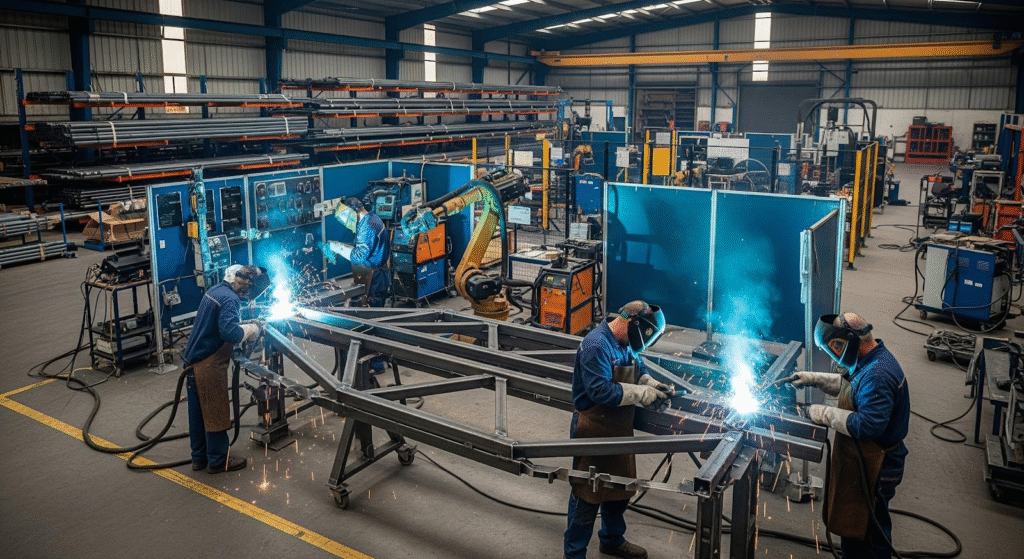
Transportation keeps Canada in motion. From trains and highways to seaports and airports, moving product and people from point A to point B is what’s at the heart of the nation’s economy. Much of this equipment and infrastructure is propelled behind it by welding. Welding firms are where the power and toughness enter to construct and service the networks that facilitate the flow of transport. What they produce is not always visible, but it is the foundation for every mode of transportation between two locations.
Table of Contents
Constructing Strong Foundations
Transportation begins with infrastructure. Overpasses, bridges, tunnels, and railroads all involve welded steel. Welding firms manufacture and build structural components that bear heavy loads and endure the wear and tear of a workday. A single bridge may represent a thousand welded joints, each critical to its integrity. Rails and rail supports rely on welding as well for strength and longevity. Cross-country transport and daily commutes to and from the workplace would not be feasible in the volumes Canada requires without welded infrastructure.
Keeping the Rail Industry Running
Rail is Canada’s oldest and most vital mode of transportation. It links harbors with interior cities and transports commodities such as timber, coal, and grain between provinces. Welding firms assist in the construction and maintenance of locomotives, railcars, and track infrastructure. Railcars face regular operation, and as such, welders are constantly busy mending cracks, reinforcing joints, and extending service life. Welding also helps with the upgrading of railways, from high-strength steel parts to new passenger trains with a focus on safety and efficiency.
Driving the Motor Industry Forward
The motor industry is also one in which welding has a tremendous influence. Cars, trucks, and buses are manufactured by factories in Canada for domestic consumption and export. Almost every car frame, body, and chassis panel is built by welding. Sophisticated methods such as robot welding provide accuracy and reliability on massive production lines. Small repair shops perform repairs, overhaul, and specialty fabrication. Whether repairing truck trailers or restoring school buses, welders return vehicles to the road and operating status.
Essential to the Aviation Industry
Aircraft need some of the most precise and safest modes of transportation. Companies that weld in this industry typically work with specialty metals like aluminum and titanium. They produce and repair components like engine parts, landing gear, and fuel systems. A weld defect could have catastrophic effects, so this industry requires very skilled welders and stringent quality control. In Canada, air travel offers connectivity between remote areas and facilitates trade, and welding services help to keep aircraft safe and reliable.
Maritime and Shipping Services
Waterways and ports in Canada are clogged veins for shipping and transportation. Ferries, offshore platforms, and ships all employ welded structures. Hulls, docking structures, cargo units, and pipelines are constructed and repaired by welding companies. Saltwater is harsh on metal, with corrosion and destruction ensuing, so constant welding repair must be done. Welders are also employed to construct icebreakers and other ships that will operate in Canada’s northern oceans, with the ability to withstand harsh conditions. Without them, sea travel would frequently be halted.
Keeping Public Transit Moving
Public transport is yet another sector where welding firms are of utmost importance. Buses, subways, and trolleys all have weldments. With the growth and growth of cities in Canada, welders assist in the construction and repair of vehicles, stations, and maintenance facilities. Repair is particularly crucial because public transport vehicles run each day and transport thousands of people. Welding services assist in the prolonging of fleets, cutting downtime, and keeping costs low for cities and transit authorities.
Repair and Maintenance Across the Industry
Regardless of the mode of transportation, repair and maintenance are always a part of the picture. Welding businesses are frequently summoned to repair damaged equipment, reinforce weak points, and restore equipment to safe operating status. This ranges from small delivery trucks to gargantuan cargo ships. Mobile welding reduces the complexity by taking the work to shipyards, railroad stations, or wharfs. It saves time and allows transportation networks to keep running with little interruption.
The Advantages of Embracing Modern Technology
Modern technology is revolutionizing the manner in which welding complements transport. Automated welding, computer-controlled cutting, and high-tech inspection devices are increasing precision and speed. These technologies serve to keep pace with the demand for more powerful, lighter, and more efficient transport systems. Car manufacturers, for instance, utilize robot welding to create every automobile chassis uniform, while aircraft welders utilize high-tech vision to spot small imperfections. By embracing emerging technology, welding firms are enabling Canada’s transport sector to compete on a global stage.
Reliability and Safety
Safety comes first in transport, and welding businesses are smack in the center of it. Durable, trustworthy welds avoid failure that would lead to accidents or expensive downtime. In the aviation and rail industries, welds are inspected and certified to very high standards of regulation. Welding businesses do not just offer qualified operators but also guarantee adherence to industry standards. Safety emphasis saves crew, passengers, and freight, and makes transport more reliable.
The Bigger Picture
Welding companies do more than joining metal components together. They support the infrastructures that allow products to move from province to province, people to travel to work, and visitors to explore the country. Their skill ensures that infrastructure, machinery, and locomotives are built to last for years, even decades, to come. As Canada keeps investing in transportation and network growth, welding Hamilton services and expertise will be at the core of the initiative. They give the industry its strength, accuracy, and dependability.